Cleanroom Safety Training
NOTE: All Training and Testing Materials serve as a summary of basic chemical safety precautions while utilizing the Nanofabrication Facility Cleanroom located at Louisiana State University/ Louisiana Light Source (LLS). This document is for LSU cleanroom users ONLY and not intended as a general reference guide or other source regarding chemical safety.
Why Safety Training?
The cleanroom is a laboratory setting full of potential hazards which include but are not limited to electrical, radiation, chemical and thermal risks. Since everyone working in the cleanroom is not equally familiar with all the risks, this document will serve as a basic overview of potential hazards and guidelines regarding chemical use.
Chemical Definitions
- Toxic chemicals make you sick if you breathe, swallow, or touch them.
- Corrosive chemicals burn or damage human skin, eyes, nose or lungs and dissolve metal.
- Flammable chemicals burn easily. These are most frequently typified by organic solvents.
- Solvents can dissolve another substance and remove protective oils or lubricants on the surface of our skin. Common solvents used in the cleanroom include acetone, ethanol, and isopropyl alcohol
- Oxidizing chemicals produce oxygen when mixed with organics or solvents which create a fire hazard. Such compounds are known as oxidizers or oxidants and are irritating to the skin, eyes, nose, and lungs.
- Acids are chemicals which corrode metal. Etchants and developers are typically acids. All acids burn the skin, eyes, nose, and respiratory tract if you come into contact with them. An alkali, also known as base, is a caustic water-soluble substance which has the capability to burn the eyes, skin, and respiratory tract. It is used to neutralize acids.
- Asphyxiants are gases which may be non-toxic (such as nitrogen) but may cause fainting or even death if it replaces the available oxygen in the air.
- Carcinogens are compounds which are known to produce cancer. All biological effects, suspect carcinogens and mutagens will be listed on the Safety Data Sheet (SDS).
- Caustic is a base (alkali) which burns the eyes, skin, or respiratory tract. Most bases (alkali) are called caustic.
- Combustible substances are those that will burn above 100F.
- Corrosives are materials which attack metal and will burn human skin. Both acids and some bases are corrosive.
- Cryogen is a substance that will freeze your skin at extremely low temperatures
- Hazardous implies that using a particular substance carries with it some risk.
- Flash Point is the temperature at which a liquid or volatile will give off enough vapor to start a fire if an ignition source is present.
- Incompatible describes chemicals which react dangerously when mixed or used together.
- Oxidizer is a material which either releases oxygen by itself or when mixed with organics or solvents. This oxygen is combustible and can present a fire hazard.
- Odor Threshold is the smallest concentration of a chemical detectable by most humans.
- Hazard Communication is dictated by OSHA (the Occupational Safety and Health Administration) which requires workers to be informed of their workplace hazards.
- Safety Data Sheets (SDS) - is a detailed document that provides critical information about hazardous chemicals, including their properties, risks, and safe handling procedures. This document is prepared by the manufacturer of a chemical to provide comprehensive information about the substance’s physical and chemical properties, health hazards, and safety precautions. Its primary purpose is to protect workers and ensure safe handling, storage, and emergency response in workplaces where hazardous chemicals are used or stored.
- Personal Protective Equipment (PPE) are those items designed to protect individuals working with hazards. They may include gloves, face shields, safety glasses, and respirators.
- Permissible Exposure Limit (PEL) is the maximum legally allowed exposure to a hazardous substance in an 8-hour time limit (normally).
Chemical Characteristics
- Acids commonly used include acetic, hydrochloric, sulfuric, nitric, and hydrofluoric. All acids are corrosive and will burn skin and eyes upon direct contact. Mists of these acids will irritate the eyes, nose, and throat. You must wear eye protection, proper gloves, when you work with acids. Hydrofluoric acid (HF) and mixture like BOE (Buffered Oxide Etch) present special problems. They look like water and if they fall on your skin, you may not feel anything, but HF will continue to burn until it reaches the bone. Contact Shaloma Malveaux for the required training to use acids in the cleanroom.
- Organic solvents are used to dissolve oils, fats, and grease or to decrease metals. They are also contained in photoresists and developers. Solvents can evaporate quickly and can represent fire or respiratory hazards and can be readily absorbed through the skin.
- Oxidizers are materials which decompose or react rapidly and release oxygen. Such materials can cause fires or explosions. Always wear gloves, eye protection when working with oxidizers (such as peroxide).
- Cryogenic gases such as nitrogen and helium can cause explosions, frostbite or the production of asphyxiating gases if improperly handled.
Chemical Use
- Users must supply the SDS for all chemicals brought to the NFF for use in the cleanroom. Also familiarize yourself with the chemicals you are using. The chemical label on the bottle will have useful information but it is also imperative that users review the SDS sheets.
- Labeling is required for all chemicals stored in the cleanroom. (Name, Date, Department). All chemicals intended for disposal will also require specific labeling guidelines under the advisement of LSU Environmental Health & Safety. Further instructions will be discussed during the cleanroom protocol lecture. Users must contact Shaloma Malveaux to schedule the training session which will be via Zoom.
- Solvents, developers, resist, and other various chemicals are stored in cabinets outside the cleanroom. Never hand - carry any chemical from outside cabinets into the cleanroom. Place item in a rubber bucket. Red and black buckets are found in the cleanroom gowning area.
- The LLS is directly connected to the LSU police station via a keltron system. Whenever a fire alarm is pulled, it immediately sends a taped message to the LSU police who will then inform Baton Rouge fire protection personnel.
- The NFPA (National Fire Protection Association) ratings are used at the facility. This system was chosen because the LLS must rely on the city of Baton Rouge for fire protection. All employees, users, and students working at the facility must familiarize themselves with this system. (see details below)
NFPA Diamond
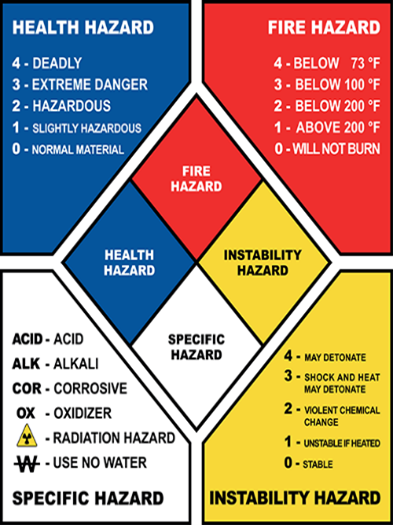
- The Red diamond in the NFPA symbol identifies flammability/fire hazards. Most organic substances will burn. Flammability is related to the flashpoint of
the material which is in turn related to the vapor pressure of the material. Many
solvents will readily evaporate, such that the concentration in air rapidly rises
and will burn, ignite, or explode when exposed to an ignition source.
Substances such as H2O will not burn and have a flammability rating of zero. Those chemicals which have a flashpoint above 200F, have a flammability index of (1). If the flashpoint is >100F, but less than 200F, then the chemical is given a rating of (2). Substances which are volatile or even explosive under most conditions and have flashpoints below 100F, receive a rating of (3). Those chemicals whose flashpoints are below 74F are given a rating of (4) and can ignite under normal conditions. - The Yellow diamond in the NFPA symbol identifies reactivity and instability hazards.
Compounds that are stable and will carry a rating of (0). Those compounds which may become unstable with elevated temperature or pressure will have a rating of (1). Substances which have a slight potential to become unstable even at normal temperature and pressures will have a rating of (2). Such chemicals can undergo potentially violent reactions. A rating of (3) indicates that the materials are potentially explosive. Heat, shock waves or water (if it is incompatible) may detonate such materials. - The Blue diamond gives information on personnel and health hazards. (0) means there is no hazard, (1) slight hazard, (2) protective equipment should
be worn, (3) do not expose body surface and (4) any exposure could be life-threatening.
These numbers do not identify whether the hazard is contact or respiratory etc. This
information must be obtained from the MSDS, which will also identify the appropriate
personnel protective equipment.
- The White diamond identifies materials, or other compounds for which the labeled chemical is incompatible and should not be used together.
Policy/Procedures
Click here to view the LLS Emergency Procedure/Experimental Hall Policy. Review this information for your safety and follow the guidelines described in the event of an emergency.
To proceed with cleanroom access, take the Cleanroom Safety Test and select a date to attend the Cleanroom Protocol Lecture at the end of the test.