


The Student Conduct Process, Outcomes, & Support
The Conduct Process is in place to determine if a student is responsible for violating the Student Conduct Code or other campus regulations.
The process is comprehensive, inclusive, and intends to educate and empower students to take responsibility for their choices, take steps toward resolution, and develop their personal standards in pursuit of academic and personal integrity.
Understanding the Conduct Process
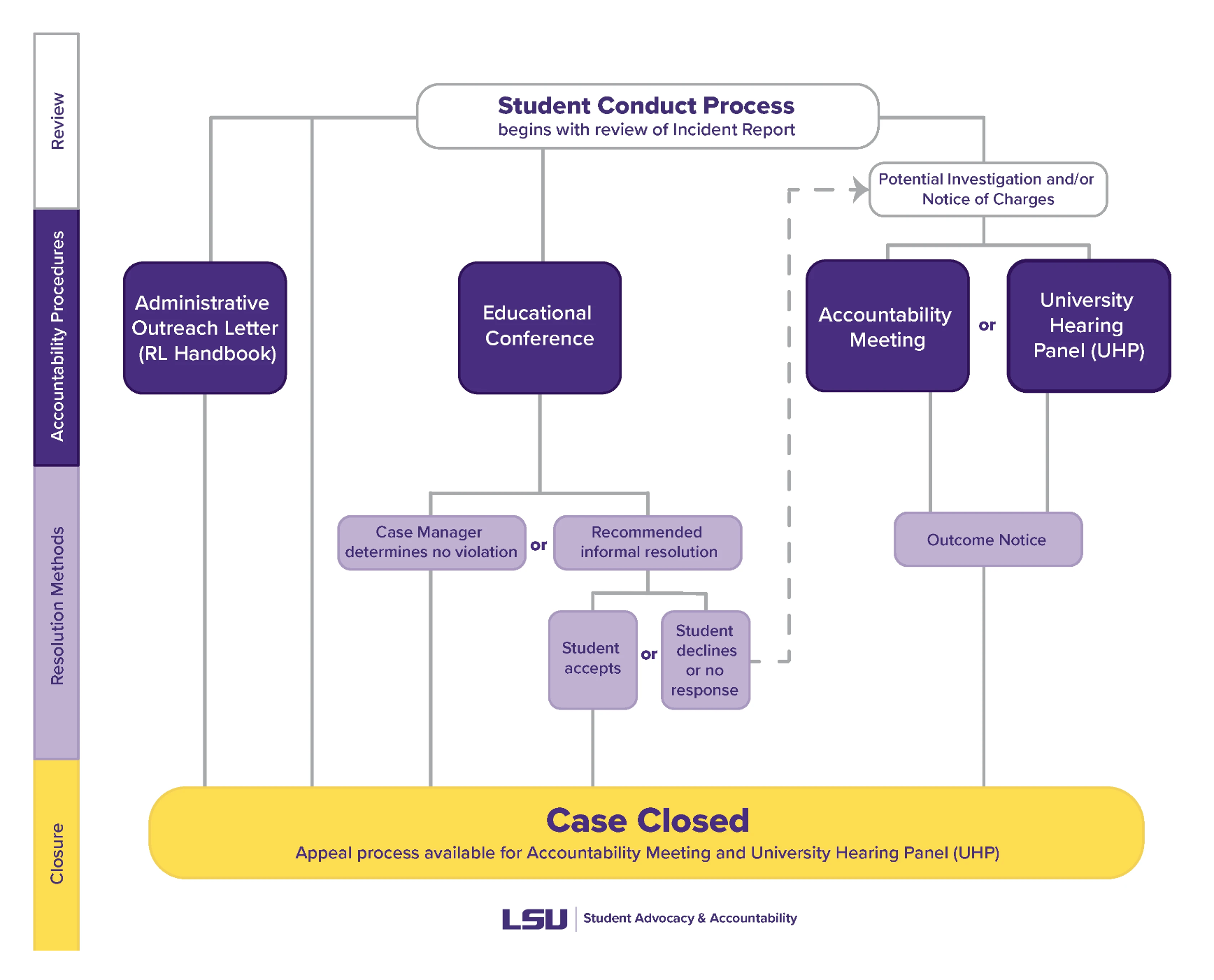
If you just received notice of a Student Conduct case, it is natural to be a little nervous. Our goal is to answer your questions about what to expect from the Accountability Process at LSU. Review the steps below in detail so that you can act as honest and active participant throughout the review, meeting and procedures, and resolutions stages of the accountability process. Although this page serves as a quick-reference resource to assist you, you should also review the Code of Student Conduct for the full details of the student conduct process. Members of student organizations should view the Student Organization Partnership Process.
A Note About Jurisdiction
Accountability procedures, including University Hearing Panels are not a court of law. However, because alleged violations of the Code of Student Conduct may or may not also be violations of local, state, or federal law, some violations may result in an arrest on and off campus. LSU also has the discretion to extend jurisdiction over conduct that occurs off campus when the conduct would be in violation of the Code if the conduct had occurred on campus. Learn more about Jurisdiction of the Code in section 5.0 of the Code of Student Conduct.
Accountability Procedures: Conferences, Meetings, and the University Hearing Panel
Depending on the type of incident and severity of the charge, accountability procedures may include one or more of the following:
After receiving information supporting an alleged violation, the Associate Dean of Students will assign a Case Manager to the case.
A University Hearing Panel will be convened in cases where suspension or expulsion are possible outcomes if the
The Case Manager will send a Notice of University Hearing Panel to the student’s LSU email address. This notice will include the alleged policy violations; any documentation which was reviewed in determining the alleged policy violations; the date, time and location of the UHP; electronic access to the Hearing Packet; notice of the students’ rights, including the right to be represented by an attorney or non-attorney advisor; the names of any material observers; and the names of panelists.
The UHP consists of three (3) to five (5) voting members made up of students, faculty, and staff. The UHP must have three (members), including one student and one faculty member to reach a quorum. One member of the UHP will serve as the Chairperson. The University will maintain a verbatim record of the UHP and will remain the sole property of the University, but a respondent can request a copy of the recording at the conclusion of the UHP.
The UHP may proceed in absentia. The SAA Official who participated in an investigation or an Accountability Meeting may participate in the hearing as a Material Observer. An Outcome by the UHP finding the Student Responsible for a violation of this Code shall be based solely on the information presented at the hearing. A majority vote of the Panel members present is required to find a Student Responsible and/or Not Responsible for violation(s) of the Code.
View the UHP Guide for Students to use in preparing for the University Hearing Panel. (If you have trouble accessing this document, contact dossaa@lsu.edu.) Students are also encouraged to ask questions about the process to SAA staff after reading the guide. Questions can be sent via e-mail to the SAA Official or to dossaa@lsu.edu.
After receiving information supporting an alleged violation, the Associate Dean of Students will assign a Case Manager to the case.
The Case Manager will review the information and then inform the student(s) involved in writing, requesting to meet with them during an educational conference. Upon receiving the notification from Student Advocacy & Accountability, the student should note the educational conference’s meeting date, time and location included in the letter. This meeting is scheduled with the student's class schedule in mind; however, students are able to reschedule by calling the SAA office. We ask that the student reschedule the meeting within five business days of the original meeting date.
The educational conference is held with a Case Manager from SAA who will provide the student with an opportunity to respond to the allegations, including without limitation, an opportunity to present information concerning the allegations and identify witnesses whom the student believes should be interviewed by the Case Manager to obtain additional information. This educational conference is informal in nature and the student will be asked to share information about the incident in question. Students may have an advisor present for the meeting.
Once the Case Manager has gathered all relevant information, they will communicate an informal resolution to the student. The student will have five business days to accept the informal resolution. An informal resolution will not be considered a part of a student’s permanent record, except for cases resulting in suspension, expulsion, or revocation of degree. SAA will not share any records with any external requesting agencies, unless required to do so by law.
Upon accepting an Informal Resolution, the student waives all rights to a formal hearing. The student may not revoke or appeal an Informal Resolution.
If the student does not accept the Informal Resolution, the case will move to an Administrative Hearing, or a University Hearing Panel if there is a possibility of suspension or expulsion.
After receiving information supporting an alleged violation, the Associate Dean of Students will assign a Case Manager to the case.
The Case Manager will meet with the student during an Educational Conference. The Case Manager will send an Informal Resolution to the student upon the completion of an Educational Conference or if the student does not attend an Educational Conference. If a student does not accept the informal resolution, the case will go to an Administrative Hearing.
The Case Manager will send the student a Charge Letter from Student Advocacy & Accountability, the student should note the Administrative Hearing meeting date, time and location included in the letter. This meeting is scheduled with the student's class schedule in mind; however, students are able to reschedule by calling the SAA office. We ask that the student reschedule the meeting within five business days of the original meeting date. Students will also be asked to prepare a written statement, which may be prepared in advance and the student will bring the statement with them to their accountability meeting.
The Administrative Hearing is held with a Case Manager who will administratively review the information presented by the reporting person and the charged student. During the Administrative Hearing the charged student will be asked to share information about the incident in question. Students may have an advisor present for the meeting. Once the Case Manager has gathered all relevant information, they will determine if the student is Responsible or Not Responsible by a preponderance of the information. If the Case Manager determines that the student is Responsible, they will then issue an accountability outcome administratively to the charged student via letter.
The student may appeal the decision to an Appeals Board that is scheduled to meet weekly.
After receiving information supporting an alleged violation, the Associate Dean of Students will assign a Case Manager to the case.
In certain situations, as outlined by the LSU Uniformed Code of Infractions, a Registered Student Organization may opt into an alternative process to address alleged violations of university policy. This Partnership Process, will allow RSOs and their student leaders to take a role in holding their organizations accountable by leading an internal investigation, developing a written report of findings, and creating an agreed upon Enhancement Plan to address violations of university policy. This is done with the assistance and guidance from a Case Manager in SAA. Learn more about the Partnership Process.
Potential Outcomes
Accountability Outcomes are issued via letter, sent to the student's LSU e-mail address. Outcomes include deadlines, details and specific instructions for completion. Registered Student Organizations (RSO’s) also receive outcomes and will be sent the president or primary contact for the organization.
A written warning issued to a Student or RSO, indicating that Responsibility for a violation of the Code. This will be in effect for a specified time period and will not be recorded on the Student’s academic transcript.
- Disciplinary Probation is a status for a specified period of time during which any further violation of the Code or University policy jeopardizes the Student(s) or RSO's status with the University.
- Disciplinary Probation with restriction includes loss of privileges, including but not limited to, removal from residential facilities, inability to hold a position of leadership in a registered Student organization, participation in intramurals, LSU study abroad programs, and/or other representation of the University.
- Disciplinary Probation without restriction would allow students to participate in Student organization leadership, intramurals, studying abroad or other specified co-curricular activities.
- Disciplinary Probation will not be recorded on the student's academic transcript except in cases of Academic Misconduct. For a first-time violation, that is not serious in nature, undergraduate students typically remain on disciplinary probation for 1-2 semesters.
- Disciplinary probation for an RSO may include, but is not limited to, loss or limitation of social events or inability to participate in University events or activities.
The Director of SAA and/or designee(s) may impose Interim Measures prior to the conclusion of the Accountability Process related to an alleged violation upon reasonable belief that a Respondent’s continued presence on University-controlled property or at University-affiliated activities constitutes an immediate threat of harm to students, other individuals, or University premises. Interim Measures may vary depending on the nature of the allegation of misconduct, status of Respondent, or other criteria and may include, without limitation, issuing a timely warning to the campus community, separating the parties, placing limitations on contact between the parties, interim suspension from Campus, or making alternative workplace, classroom, course scheduling, dining, or student housing arrangements. Interim Measures will be subject to the following procedures:
- Written notice of the alleged violation and reasons for enacting the Interim Measure must be provided to the Respondent within seventy-two (72) hours of determination of an immediate threat of harm to students, other individuals, or University premises.
- Within seven (7) business days of the written notice of Interim Measures, unless waived
by the Respondent, an Interim Measures Hearing will be conducted to determine whether
there is substantial evidence that the Respondent poses an immediate threat of harm
to students, other individuals, or University premises and that the Interim Measures
are appropriate to mitigate that risk. During such hearing, the Respondent and alleged
victim (if applicable), may be represented by an Advisor. Such hearing will be conducted
by the Dean of Students and at least one other designee. The Interim Measures Hearing
may result in a continuance of, revocation of, and/or modification of the Interim
Measures.
- Respondents reinstated to the University following an interim suspension under this Section will be afforded the opportunity to make up academic work missed during the period the suspension was imposed. It is the responsibility of the Respondent to make arrangements with instructors for completing missed work.
- In cases where interim suspension is upheld as a result of the Interim Measures Hearing, the suspension will remain in effect until a final outcome is reached through the Accountability Process.
- If Respondent is unable to attend the Interim Measures Hearing, the Hearing shall move forward in absentia.
Suspension is the physical separation from the University for Misconduct. A Student may be suspended for at least one semester and/or for multiple years. The Suspension may be delayed at the discretion of the Dean of Students and/or SAA. Students Suspended from the University may be readmitted if they meet the Admissions requirements to the University, degree granting College and if approved by the Dean of Students and/or SAA. When a Student is Suspended from the University, he or she may NOT be on Campus without specific written authorization by the Dean of Students and/or SAA. Suspension from the University will be recorded on the Student's academic transcript.
An RSO may be suspended for no less than one semester. The suspension may be delayed at the discretion of the Dean of Students and/or SAA. Suspension will include rescission of University registration. An RSO that has completed a period of suspension may seek reinstatement by complying with the registration requirements of the appropriate University department.
Expulsion is the permanent separation of a Student from the University without the possibility of readmission. When a Student is expelled from the University, he or she may NOT enter or remain on Campus without specific written authorization by the Dean of Students and/or SAA. Expulsion will be recorded on the Student's academic transcript.
A Student or RSO may be directed to cease all communication and contact with another Student, group of Students, Instructor, or other University employee or contractor. Under a no contact directive, a Student may be prohibited from entering or remaining in or around a specified University building, facility or area of campus. This may also be issued as an interim measure in cases where it has been determined that a Student or RSO can be a threat or harm to others
In situations involving Academic Misconduct, a Student may be assigned a failing grade for the work in question, may receive zero credit, no credit or partial credit for the work in question, may have the student's overall class grade lowered by one letter, or may receive a failing grade for the course. The first violation for an undergraduate student may result in a failing grade for the work in question and the overall grade lowered by one letter; while the first violation for a graduate student may result in a failing grade for the course. Students who are found responsible for a violation of academic misconduct may not drop the course in which the misconduct occurred. If a student does attempt to drop the course, they will be reenrolled by the Office of the Dean of Students and/or SAA.
A student may accept an informal resolution in behavioral misconduct cases. An informal resolution will not be considered a part of a student’s permanent record, except for cases resulting in suspension, expulsion, or revocation of degree. SAA will not share any records with any external requesting agencies, unless required to do so by law. Upon accepting an Informal Resolution, the student waives all rights to a formal hearing. The student may not revoke or appeal an Informal Resolution.
Case Closure
Student Records
Accountability cases and records are considered confidential records of the university and are maintained by the Office of the Dean of Students. Read more about your records below.
An Informal Resolution will not be considered part of a Student’s permanent record and therefore will not be shared with any external requesting agency, unless required to do so by federal and/or state law, or in the case of suspension, expulsion, or degree revocation. A record of an Informal Resolution will be shared within SAA and any future University Hearing Panel (UHP) in order to determine appropriate future Informal Resolution or UHP Outcome. An Informal Resolution may be shared with a University department to determine eligibility for certain University programs, scholarships, student organization officer requirements, or activities.
Files for suspensions, expulsions, and violent offenses are maintained indefinitely. All other formal finding files are maintained for at least seven years. At the end of the seven-year period, the files may be destroyed in accordance with the University’s record disposal policies.
Who Has Access
In accordance with the Family Educational Rights & Privacy Act (FERPA) of 1974, a student may examine their accountability records. However, these records are generally not available to persons outside the University except in accordance with state and federal law.
University personnel or University legal counsel may have access to accountability records of individual students only if such information is needed in the performance of duties assigned to that person.
Review Your Own Records
Students should notify Student Advocacy & Accountability by calling 225-578-4307 if they would like to review their accountability records. A time will then be scheduled for the review.
Appeals
A student or Registered Student Organization (RSO) can appeal a hearing decision to the Student Conduct Appeals Board.
Please note, cases resolved through the Informal Resolution process are not eligible for an appeal.
An appeal must be submitted in writing within ten (10) business days after the outcome is issued.
The student or RSO’s attorney or non-attorney advisor may submit an appeal.
An appeal may only be considered by the Board on the following grounds:
- A significant departure from procedures
- New information has become available
- The determination of responsibility or outcome is the result of substantial disregard of the information presented
- Evidence of bias
If the Appeals Board determines that one of the above referenced grounds has been met, the following may result:
- Outcome is upheld
- The case will be sent to a new Administrative Hearing or University Hearing Panel to be correct a procedural error(s)
- Reversal or modification of the hearing decision and/or outcome
If the Student Conduct Appeals Committee decision involves a suspension or expulsion, the Dean of Students, or designee, has the discretion to review the decision and may modify or uphold the Student Conduct Appeals Committee decision prior to the issuance of the appeal outcome notice to the parties. All degree revocations must be reviewed by the Dean of Students, or designee.
Student Rights & LSU Jurisdiction
What if I don't want to participate in the process?
When a student or Registered Student Organization fails to attend an Accountability Meeting, a Case Manager may proceed through the Accountability Process without them in attendance. If the Director of Student Advocacy & Accountability (SAA) or designee determines that the failure to appear is due to compelling circumstances, SAA may reschedule the meeting.
Your Rights & Requesting an Advisor
When an incident arises that warrants a conversation about the Code of Student Conduct and university expectations, a staff member will be in contact with you via your LSU email address. You should read all emails and information thoroughly and follow any instructions or suggestions provided. Choosing to not engage in the process does not eliminate your involvement in the incident and the process (including any investigation, informal meetings, or formal hearings) may continue to move forward without your involvement.
Accountability Advisors are faculty, staff, and graduate students who have been trained to assist students through the Accountability Process.
Advisors can:
Help students understand the accountability process and discuss available options
Help students prepare for meetings, formulate questions, and gather supporting documentation
Advisors cannot:
Serve as a Material Observer and Advisor simultaneously
Section 6.1 of the Code of Student Conduct outlines your rights as a student moving through the Accountability Process.
Legal Assistance
LSU does not have a legal assistance program at this time. However, there are other
options within the Baton Rouge community which may be helpful to you.
Baton Rouge Bar Foundation Pro Bono Project
The Baton Rouge Bar Foundation Pro Bono Project is dedicated to improving equal access to justice for all and has been making a meaningful
change in people’s lives since 1986.
Ask-A-Lawyer
Ask-A-Lawyer provides walk-in legal clinics several times a month at several locations throughout
the greater Baton Rouge area.
Southeast LA Legal Services
provides free, civil legal aid to low-income people in six offices, across 22 parishes
throughout southeast Louisiana.
Additional Legal Support Resources
Conduct Process vs. Criminal Justice Process
Proceedings under this Code may be carried out prior to, simultaneously with, or following any civil or criminal proceedings.
LSU also has the discretion to extend jurisdiction over conduct that occurs off campus when the conduct would be in violation of the Code if the conduct had occurred on campus.
Learn more about Jurisdiction of the Code in section 5.0 of the Code of Student Conduct.