
LSU’s SEM Upgrade Powers Geological Discovery
January 20, 2026
Groundbreaking research often requires tools that let scientists see beyond what the human eye can detect. At LSU, two professors in the Department of Geology and Geophysics, Assistant Professor Eirini Poulaki and Assistant Professor Brandon Shuck, are leading a transformative upgrade to the Scanning Electron Microscope (SEM) housed in the LSU Advanced Microscopy and Analytical Core (AMAC), giving researchers clearer, deeper views into the materials they study.
Supported by the LSU Provost’s Fund for Research in Innovation and additional funding from the General Fund of the Department of Geology and Geophysics, upgrading the SEM with the advanced AZtec software allows researchers to study material properties on the nanoscale with unprecedented clarity, exploring realms more than a thousand times smaller than the width of a human hair.
While the SEM already reveals the hidden architecture of materials, researchers have long been forced to choose between viewing fine details or broader structural patterns. The key benefit of the new software is that it removes this limitation, enabling automated, high-resolution imaging across wide sample areas and providing critical insights into how complex materials form, deform, and fail under real-world conditions.
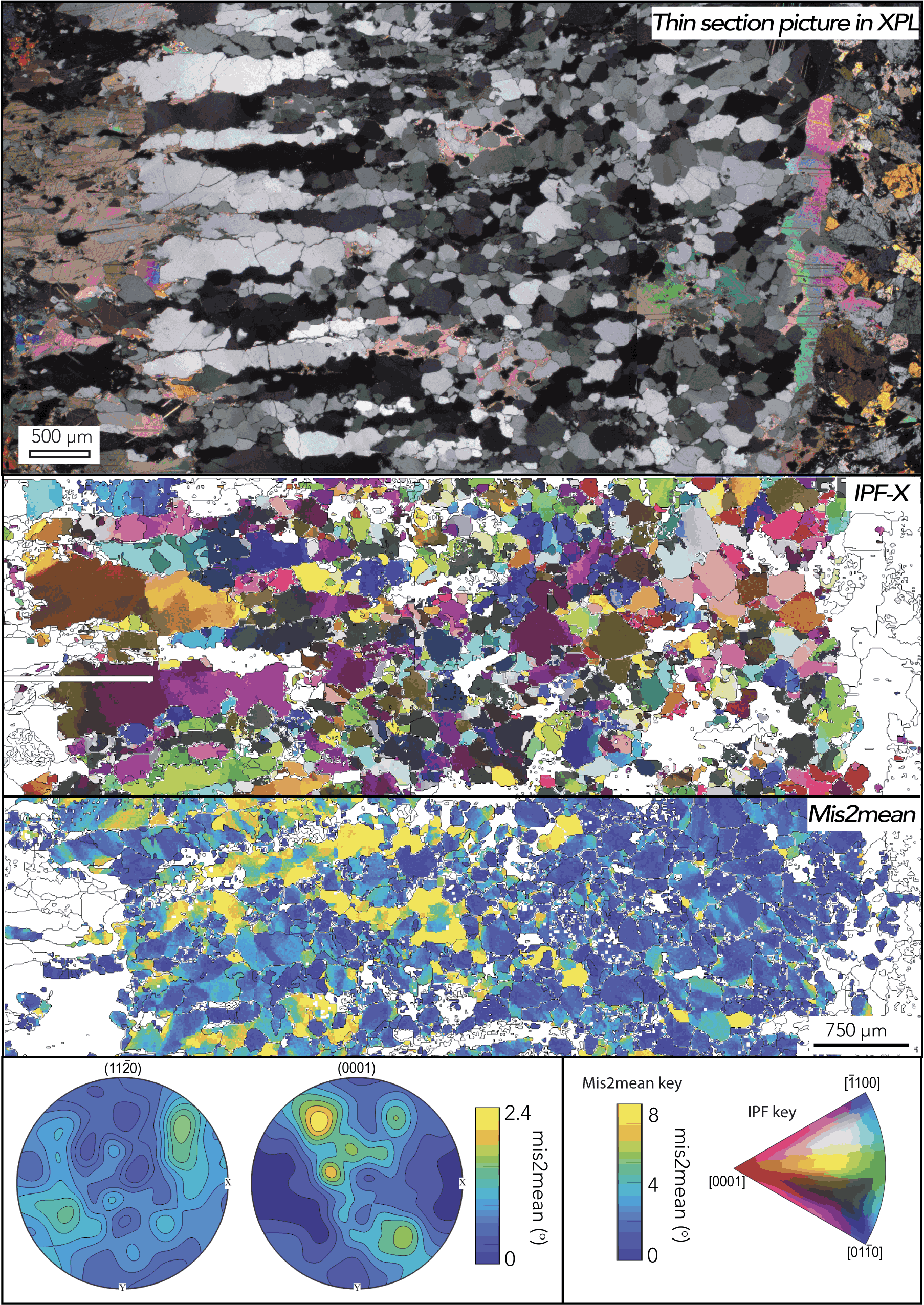
Top panel: Thin section picture of quartz vein in cross polarized light. Mis2mean: Map of misorientations mapped by the large area Aztec software capabilities that LSU now has access to. This map shows the internal misorientation within the quartz grain, showing how much each point deviates from the grains' average orientation. IPF-X: A map that shows the crystallographic orientation of grains; different colors represent different quartz crystal orientations. Bottom panel: Pole figures showing crystal prefer orientation along the c and a quartz axis and legend.
All EBSD data shown in this figure were collected at the Molecular Analysis Facility at the University of Washington using equipment similar to that at LSU, which now has the capability to obtain the same datasets.
A New Era of Geological Research: Assistant Professor Eirini Poulaki

Assistant Professor Eirini Poulaki, LSU Department of Geology & Geophysics
For Assistant Professor Eirini Poulaki, the software upgrade capability enhances the way scientists and students at LSU can investigate microscopic rock slices, which are essential for interpreting Earth’s history.
“As geologists, we study the rock record to understand how Earth works using thin sections,” she explained. “These are 30 microns thick, 1×2-inch rock slides that hold minerals as small as a few microns. These minerals’ spatial extent and relationships are fundamental for understanding the rock's geologic history.”
Poulaki emphasized that this upgrade will unlock many new research avenues for students and scientists at LSU. “We can now scan entire thin sections to find minor-in-proportion but extremely important accessory minerals such as zircon, apatite, titanite, and rutile that we can later use to date the rocks,” she explained. “The only way to identify efficiently and accurately all of these minerals and understand their spatial extent in the thin sections is by using this new software upgrade.”
With the software, researchers can now collect electron backscatter diffraction (EBSD) data to show mineral grain deformation and energy-dispersive X-ray spectroscopy (EDS) data to reveal the sample's qualitative chemical composition. These data are gathered continuously and at high resolution across an entire thin section, giving scientists a complete and representative picture of a geologic material's microstructure and chemical complexity, Poulaki explained.
Transforming Chemical Mapping: Assistant Professor Brandon Shuck

Assistant Professor Brandon Shuck, LSU Department of Geology and Geophysics
Assistant Professor Brandon Shuck is equally enthusiastic about the new analytical power the upgrade brings to AMAC, particularly how the enhanced software transforms large-area chemical mapping.
“The upgraded software enables us to conduct Large Area Mapping at extremely high resolution in a continuous scanning mode, automatically stitching the data into a dense mosaic of chemical maps,” Shuck said.
Shuck and his research team plan to utilize the upgraded system to analyze the primary minerals and alteration products formed through hydrothermal processes in oceanic mantle rocks. He explained that the resulting 2D datasets will feed into machine-learning models that extend these classifications into 3D by linking chemical information with Micro-CT X-ray attenuation data.
“This will allow us to fully characterize the heterogeneity of oceanic mantle samples and evaluate how fluids percolate through these rocks and cause chemical reactions, which are key to understanding the nature of Earth’s lithosphere and broad geochemical cycles on our planet,” Shuck said.
Positioning LSU at the Forefront of Geoscience
The SEM upgrade enhances imaging capabilities and strengthens LSU’s standing as a major center for Earth and materials science research. With faster, more detailed, and fully automated mapping, researchers can now generate datasets that were previously time-consuming or technically challenging to obtain.
“With the current instrumentation at LSU, the Geology and Geophysics Department is one of the leading scientific institutions, having almost every piece of equipment needed to understand the tectonic and metamorphic evolution of the Earth’s crust.”
Eirini Poulaki, Assistant Professor, LSU Department of Geology & Geophysics
As LSU continues to invest in its research infrastructure, the upgraded SEM demonstrates how strategic support can elevate scientific discovery across disciplines. Made possible by the leadership of Poulaki and Shuck and the LSU Provost’s Fund for Research in Innovation, the upgrade ensures that students and researchers have access to world-class tools that drive breakthroughs in Earth science, materials research, environmental studies, and beyond.