
Astra, a military working dog who protected U.S. Presidents and helped save lives in the Middle East, got life-saving assistance of her own at LSU Vet Med
December 26, 2025
Astra, a military working dog (MWD) who has deployed on Secret Service missions to protect U.S. presidents and assisted soldiers in Middle East war zones, faced a life-threatening crisis of her own in December.
Watch a reel of Astra arriving on a Black Hawk at LSU Vet Med
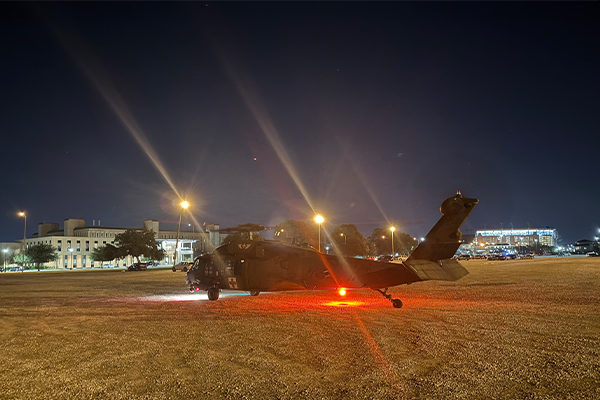
Medically equipped Black Hawk helicopter landing across the street from LSU Vet Med.
The Patrol Explosive Detector Dog was airlifted from the Joint Readiness Training Center & Fort Polk (JRTC & Ft. Polk) to LSU School of Veterinary Medicine the evening of Wednesday, Dec. 10, in a medically equipped Black Hawk UH60 helicopter to LSU’s Veterinary Teaching Hospital’s front door, where she was rushed into the Emergency & Critical Care service in the throes of hypovolemic shock.
“Our decision was to medevac her to LSU. We wanted the best and fastest care for her,” said Sgt. Pierce Getner, squad leader who trains, handles, and maintains dog teams at the JRTC & Ft. Polk, a U.S. Army training base in Vernon Parish, Louisiana.
Astra, an 8-year-old Belgian Malinois, was suffering from a continuously elevated heart rate, lethargy, anorexia, and vomiting. CPT Isabel Grazian-Hobbs, DVM, military veterinarian on duty and 2023 LSU Vet Med graduate, worked with her unit, Veterinary Readiness Activity, Fort Hood, and Bayne-Jones Army Community Hospital to help Astra and determine the best course of action to save Astra. CPT Grazian-Hobbs briefed the flight crew on what medications and support equipment would be needed in flight. Once the helicopter—staffed with a flight surgeon, handlers, pilots, and crew members—touched down, she was rushed on a gurney into LSU Vet Med’s Emergency Service, where an Emergency clinical team led by Drs. Jack Lee and Leslie Serrano went to work on saving her life.
Astra was in a life-threatening Addisonian crisis—later confirmed by tests—involving severe dehydration, electrolyte imbalances (low sodium, high potassium), low blood sugar, and collapse, requiring immediate emergency treatment with fluids and steroids to save the dog's life. A severe lack of cortisol and aldosterone (a hormone that controls blood volume and electrolyte concentrations) in dogs with Addison's Disease directly leads to the crisis.
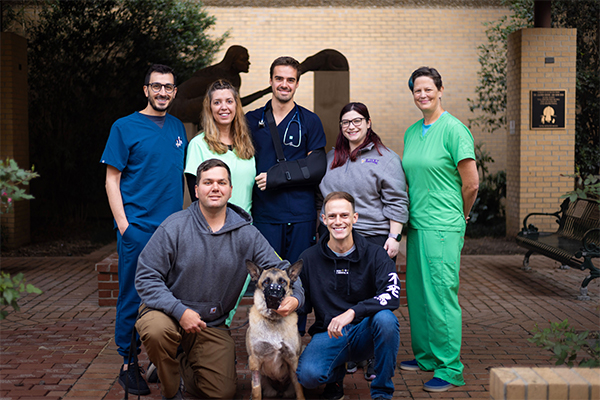
Back row from left, Assistant Professor of Small Animal Internal Medicine Dr. Agostino Buono, Veterinary Technician Ashley Benjamin, Small Animal Internal Medicine Resident Grégor Boot, Senior Veterinary Student Katherine Woolf, and Professor of Small Animal Internal Medicine Patty Lathan. Bottom row, from left, Staff Sgt. David Tatterson, MWD Astra, and Sgt. Pierce Getner.
– Photo by Chris Jones, LSU Vet Med.
“The ER team stabilized Astra. They were most important in her acute care, which allowed her to be seen by Internal Medicine to get at the root problem. It was a team effort,” said Dr. Gregor Boot, resident, Small Animal Internal Medicine, who was called in to take over the case early Thursday morning.
Testing with rapid results was crucial to determining the root cause of her illness. Maria Smith in LSU Diagnostics delivered the test results within one hour to Dr. Patty Lathan, Internal Medicine service chief, who interpreted the results that led to the definitive diagnosis.
Astra was diagnosed with Addison’s Disease, which affects both dogs and humans, according to Dr. Lathan, who is an expert in Addison’s and also has the disease herself. Addison’s has earned the moniker of “The Great Pretender” because it results in clinical signs that could be caused by many different reasons. The clinical signs can come on suddenly and severely or chronic signs can emerge gradually resulting in the dog becoming very sick.
Military regulations require that handlers of MWDs stay with the dogs at all times. Sgt. Getner and Staff Sgt. David Tatterson drove from the JRTC & Polk to LSU Vet Med to be with Astra. They slept next to her in her kennel to watch over her during nights in ICU as she recovered. When the ICU clinicians heard that the soldiers planned to sleep inside the kennel, they provided blankets to make their stay as comfortable as possible.
Overall, it was a fantastic experience at LSU Vet Med. They were so accommodating,” Sgt. Getner said.
Military Working Dogs (MWDs) are highly trained canine service members in the U.S. Armed Forces and are essential for roles like explosives and narcotics detection, patrol, sentry duty, and search & rescue while using specialized gear and saving lives. The dogs form deep bonds with their handlers and are often considered fellow warriors deserving of expert care. Belgian Malinois are a favored breed for their drive and agility. Astra has served side-by-side in combat zones with a handler who received The Combat Action Badge, which is earned by U.S. Army soldiers who personally engage the enemy in active combat in a hostile fire zone.
“We ask a lot of these dogs. Astra was in a bomb shelter for a whole month during hostile fire while deployed in Iraq for nine months. She’s been deployed more than most MWDs, and it’d be hard to imagine her putting in all of that work and not get to reap the rewards of her efforts. We want to see Astra retire, relax, and enjoy life knowing she did a good job. We want the best for her,” said Sgt. Getner, who is handler of a different MWD. “It is impossible to describe the bond you have with your dog. With my own, we were newly partnered and deployed overseas, not yet fully trusting each other. Almost overnight, we both realized, ‘It’s just me and you,’ and everything changed. We rely on each other.”
“Handlers of MWDs like Astra are great clients because they can tell us specifically what is going on with their dogs. They are so attuned to them,” Dr. Lathan said.
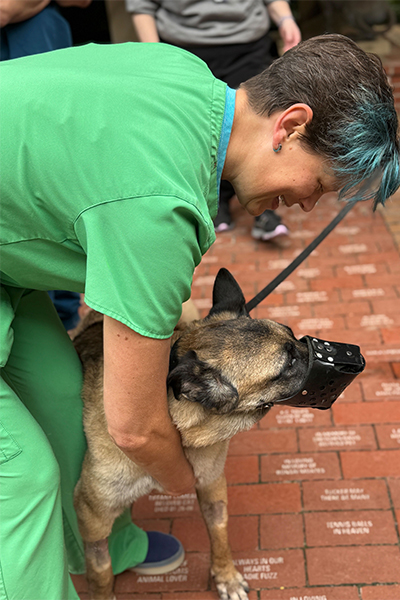
Dr. Patty Lathan with Astra.
– Photo by Sandra Sarr, LSU Vet Med.
The disease is significantly more common in dogs than in people. According to Dr. Lathan, LSU Vet Med diagnoses approximately one case of Addison’s per month in dogs brought to LSU. She notes that more Addison’s cases are confirmed when testing in LSU Diagnostics is done for other veterinarians in the region.
Astra was discharged from the hospital on Friday, Dec. 12. She will be on lifelong medications: prednisone and desoxycorticosterone to replace the cortisol (stress hormone that Addison’s prevents her body from making) and aldosterone, respectively. The medications will be adjusted over time and are expected to protect her from further episodes like the one that landed her at LSU Vet Med.
She is expected to recover fully. She will retire pending her disposition evaluation,
which determines a dog’s suitability to transition to a different role like retirement.
“Astra should have a good quality of life for the rest of her days,” Dr. Lathan said.
About LSU Vet Med: Bettering lives through education, public service, and discovery
The LSU School of Veterinary Medicine is one of only 33 veterinary schools in the U.S. and the only one in Louisiana. LSU Vet Med is dedicated to improving and protecting the lives of animals and people through superior education, transformational research, and compassionate care. We teach. We heal. We discover. We protect.